Academic Consulting: Educating for the Planetary Era
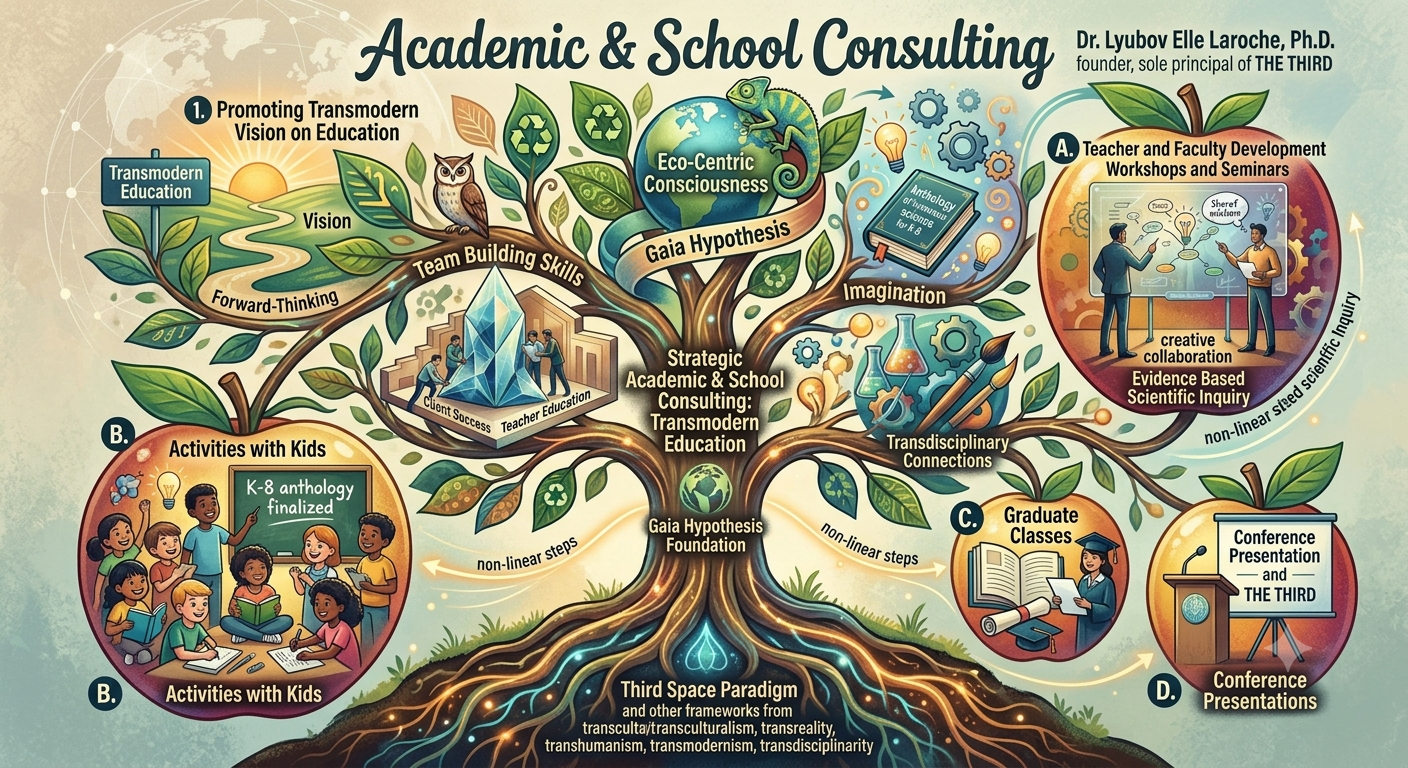
My consulting practice is rooted in a transmodern vision of education that began with my doctoral research, “You were a star once, weren’t you? Nonlinear steps into the reenchantment of science education” (2001). My dissertation is a highly transdisciplinary conceptual-philosophical essay that envisions science education grounded in insights from new science---quantum theory, the science of complexity, and dynamic systems theory, as opposed to current models based on an outdated mechanistic worldview.
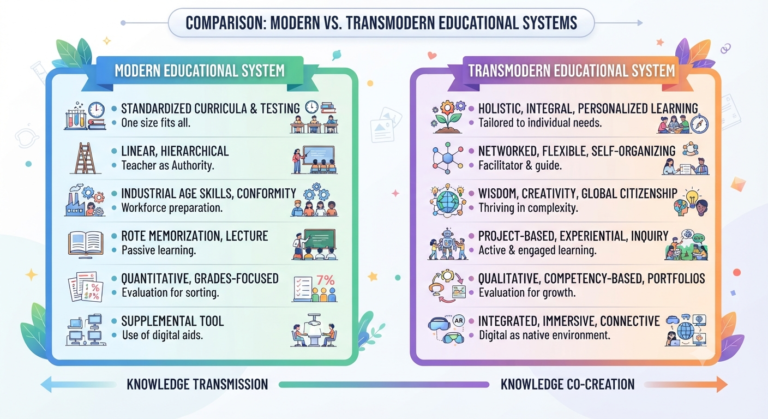
This led me to the concept of transmodernity and transmodern education. What is transmodern education? I am pioneering this approach by developing an imaginative, visionary, eco-centric, community-centric, transdisciplinary, and transcultural educational model that fosters the development of citizens for the emerging planetary era. Below is the table comparing modern and transmodern approaches to education.
I design and facilitate interactive workshops for prospective and practicing teachers, graduate students, and university faculty. These sessions are structured around engaging, developmentally appropriate topics designed to captivate elementary and middle school students.
Drawing from the principles of imaginative development, workshop themes include:
1
For younger children (Mythic stage):
Fairytales and imaginative storytelling.
2
For older students:
Science-fiction, fantasy, and speculative themes.
My Books as Teacher Resources
Grounded in transdisciplinary units published in my books—such as science poems or fairytales—these workshops go beyond content delivery. My anthology, “Science Even for Those Who Have Never Liked Science: The Universe Through Science, Imagery, and Verse”, serves as a transdisciplinary resource designed to foster eco-centric consciousness, empathy, respect for the "other", and understanding that we all are the citizens of the Earth. Furthermore, its purpose is to emphasize the magic of the world around us, introducing science not as a dry collection of facts, but as a magical, lived experience.
Within its pages, I describe integrated lesson units that weave together humorous science poems, scientific experiments, outdoor and family activities, team-building exercises, guided imagery, dramatic play, and visual art.
This book can be ordered from amazon.com and my e-boutique on this site.
The imagery of themes from the book:
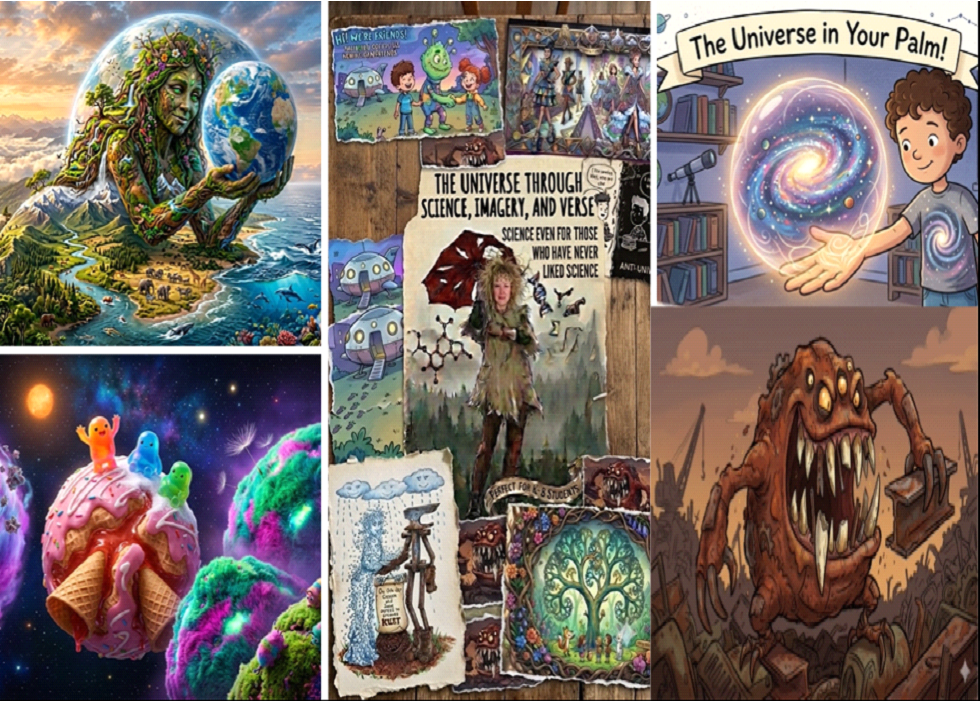
We are diving headfirst into the zany, dazzling universe of stars, matter and antimatter, enigmatic particles, dancing fractal patterns, holographic mysteries, chemical reactions, and the wild, living wonder that is Earth Gaia. Each poem is a little reminder that you are a vital, inseparable piece of this cosmic puzzle.
Video Trailer of the Book
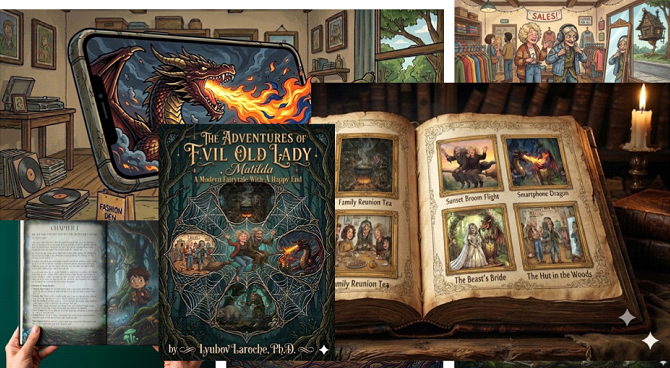
My second book “The Adventures of the Evil Old Lady Matilda: A Modern Fairytale with a Happy End “provides transdisciplinary resources for younger children, utilizing magical content specifically designed to appeal to a K-3 audience.
The imagery of themes from the book:
Video Trailer of the Book
Video Trailer of the Book
Questions after each chapter
Every chapter ends with a set of "Questions for Young Readers." These are not tests but an invitation to a conversation!
They are designed to:
Develop Curiosity:
I want to encourage you to wonder "why," "how," and "what if." By thinking deeply about the characters’ choices, you become a co-creator of the story.
Build Good Values:
Each section provides an opportunity to discuss important life lessons—like the importance of empathy (understanding how others feel), kindness, the meaning of friendship, and how to stay safe while being adventurous.
Teach Storytelling Skills:
By answering these interactive questions, you are learning how to analyze characters, predict plot twists, and build your own narratives. Every answer you give is a piece of the story we are telling together!
TABLE OF CONTENTS
A Teacher Resource
This story could serve as a versatile transdisciplinary lesson unit. Educators can integrate various subjects, including:
Language Arts:
Rewriting the ending of the story.
Visual Art:
Illustrating the story.
Science:
Exploring what can grow in dark, shaded environments.
Mathematics:
Calculating the distance between Matilda and Baba Yaga.
Social Studies:
Fostering the development of positive values.
Dramatization:
Having students roleplay the narrative as it is told line by line by class.
Educational Technology:
Designing costumes and producing a video to share with students’ families.
The Synthesis Approach
Transmodern Theoretical Vision:
My theoretical explanations are anchored in a transmodern vision of education that actively fosters transdisciplinarity, ecological consciousness, imagination, imagination, and technology, while teaching essential collaborative skills.
Curriculum Architecture:
I move beyond standard lesson planning to focus on curriculum architecture, designing structural foundations that promote deep understanding and interdisciplinary synthesis.
Integrating Complexity:
I bridge traditional subject areas with complexity science, dynamic systems, and transmodern perspectives to reveal the underlying structures of knowledge and learning.
Evidence-Based Pedagogies:
My practice is strictly evidence-based, anchored in rigorous academic research—including my own 30+ years of teaching and research experience—and my work on historical projects like the states of matter classroom study in 1997 and my 2000 publication, Curriculum Connections.
A Collaborative Partnership:
I function as a partner to work alongside academic leaders and educators, designing custom solutions that address the specific, complex challenges facing your institution or classroom today.
Proposed Educational & Academic Service Offerings
Core Pedagogical Engagements
Graduate-Level Seminars in Transmodern Thought:
Specialized, rigorous courses exploring the intersection of transmodernism, transculturalism, transdisciplinarity, transreality, and transhumanism designed for academic and professional development. The theoretical foundation to these courses is outlined in my upcoming book: my forthcoming book “The leaves are falling upwards! The journey toward THE THIRD: How can I recognize my home?”
Faculty & Teacher Development Institutes:
Interactive, fun, intensive, hands-on seminars that provide educators with the structural foundations to shift toward organic, imaginative, and student-centered pedagogical frameworks.
Community & Youth Enrichment Programs
"Discovery" Laboratory Programs:
Hands-on, transdiscipninary,inquiry-based programs for students that leverage the "magical, lived experience" of science. These programs foster eco-centric consciousness and empathy by integrating poetry, visual art, and scientific experimentation.
After-School Integrated Units:
Transdisciplinary, after-school experiences that utilize your unique lesson units—including humorous science poems, guided imagery, and dramatic play—to build collaborative and leadership skills, as well as ecological awareness.
Suggested Additional Services
Curriculum Architecture Consulting:
A bespoke service where I partner with institutions to design entire curricula applying the concepts of transmodern education, complexity science, and dynamic systems theory.
Research & Publication Mentorship:
Drawing on my 30+ years of academic research experience, I provide guidance to students and faculty, particularly in integrating complex theoretical frameworks into their writing and presentations.
"Reenchantment" Workshops:
Specialized sessions focused on my doctoral research methodology—bringing imagination, art, and poetry back into scientific inquiry to foster curiosity and respect for the "other."
Grant Writing and Fundraising Events:
Services backed by a grant-writing certificate and experience in securing more than $100,000 in grant funding.
Digital Storytelling:
Producing promotional videos about schools and programs.
Example From Youth Enrichment Program
In my article "Teaching Science Through Imagery" (2000), I described the "States of Matter" project, where fifth graders were involved in producing a video illustrating a poem included in this book (see). Initially, students were hesitant, expressing sentiments like "oh no... science again." However, they became increasingly inspired by role-playing the behaviors of gases, liquids, and solids—illustrating gas particles as independent travelers or solids that prefer solid friendships. Pre- and post-tests indicated significant cognitive and affective benefits. When describing their learning, students used organic, whimsical language; this humanizing approach is in complete alignment with the insights of postmodern organicism.
I observed the same outcomes when producing the video "Gaia" with students of various grades enrolled in an afterschool program. This video illustrated Jim Lovelock’s Gaia hypothesis, which suggests our lovely planet might be a living organism.
Below are links to videos illustrating these projects: